
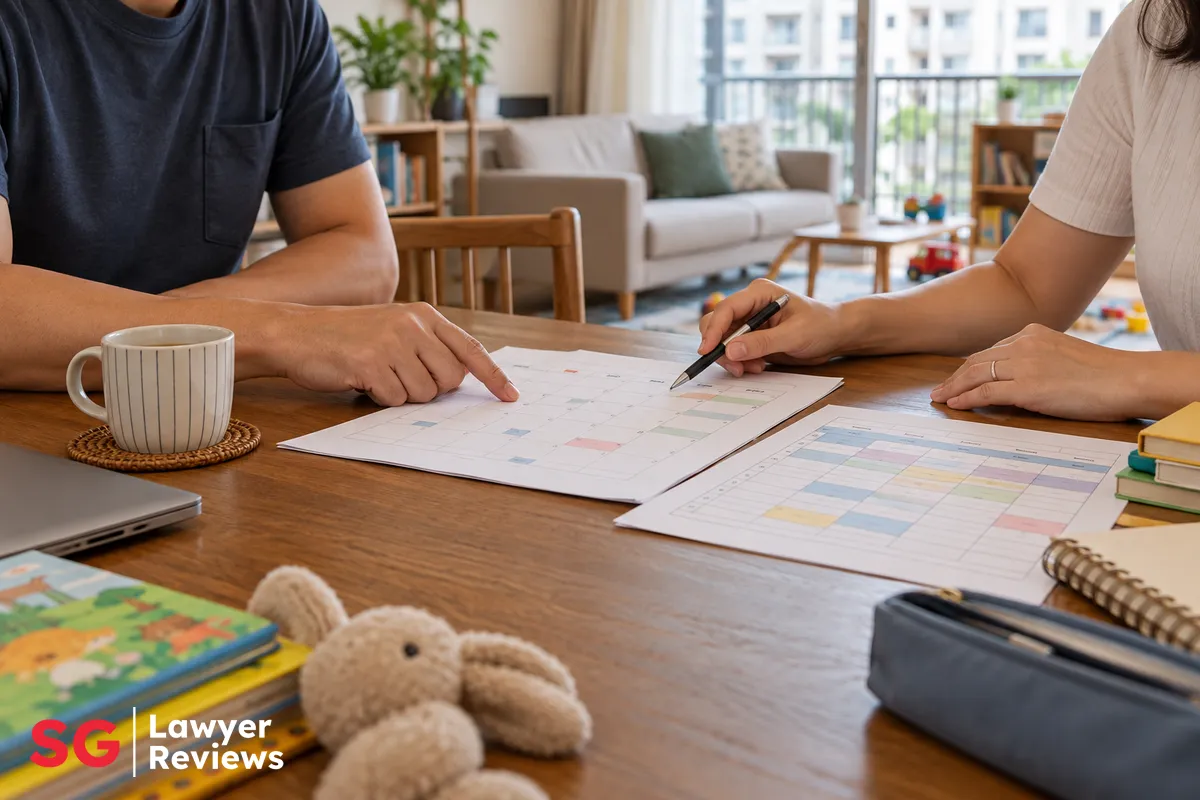
When parents agree that their marriage should end, the hardest discussion is often what ordinary Tuesdays, school holidays and sick days will look like for their child. A parenting plan turns general goodwill into practical arrangements. In Singapore, the Family Justice Courts expect parents to consider children’s welfare and the arrangements that follow divorce. This guide concentrates on building a usable plan before filing, especially when both parents want to keep the process constructive.
This article deals with parenting plan divorce Singapore through the practical decisions in a particular case. First, identify the document or event that governs your situation and the date at which action is needed. Then compare what you know with what remains uncertain. Singapore procedures may distinguish between similar-looking cases, so use the official guidance for the exact route and obtain advice where the facts are disputed.
The official framework and your own facts
The starting point is the Family Justice Courts’ divorce filing guidance. It explains the public process, but it cannot examine your signed documents, family circumstances or transaction history. Read it alongside the court’s family orders guide where that second source addresses a connected issue. Write down which statement from each source applies to your facts and which detail you still need to verify. A page about a general rule should not be turned into a guarantee of a specific order or result.
Start with the child’s weekly life
Write down the current school, childcare and after-school routine before debating an ideal schedule. Who handles morning transport, homework, medical appointments and weekend activities? A plan that ignores work shifts or the child’s travel time is unlikely to last. Use actual commuting times between homes and school. If a grandparent regularly provides care, record that support without assuming it will always be available.
Separate legal labels from daily arrangements
Custody concerns major decisions, while care and control and access address different parts of a child’s life. Parents can agree on shared decision-making yet still need a clear collection time on a Friday. Define who makes education and health decisions, how disagreements are discussed, and which parent communicates with the school. Vague wording such as ‘reasonable access’ can be a future argument disguised as agreement.
For the legal terms behind this step, our guide to custody, care and control, and access provides useful context. Read it with the exact wording of your own document in mind: the label used by another family, employer or business may hide a different practical obligation.
Give holidays and festivals their own calendar
School holidays, Chinese New Year, Hari Raya, Deepavali and birthdays can disrupt a standard weekly arrangement. Specify start and end times, overnight arrangements, notice periods and whether years alternate. Think about examination periods and a child’s need for rest. A schedule should be understandable to both households without repeated negotiation every term. Keep room for mutually agreed swaps when a family event arises.
Before calling a timetable agreed, test it across a real month containing a public holiday, a school activity and a parent’s late shift. A weekly schedule can look balanced on paper while producing repeated changes in practice. Mark travel time, meals and bedtime, then ask whether the child is the one bearing the inconvenience.
Make communication predictable
Decide how parents will share school notices, report cards and medical information. A shared calendar or email thread is often easier to follow than scattered messages. Set a sensible response window for routine issues and a different route for emergencies. The purpose is not to police each other. It is to stop the child becoming the messenger when adults disagree about dates, expenses or appointments.
Match the plan to finances and logistics
The child may need uniforms, tuition, transport and healthcare across two homes. Do not assume a time-sharing calendar settles child maintenance. Record which expenses are recurring, which need prior agreement and how receipts will be exchanged. Consider who holds passports and important documents. A parent working irregular hours may need a backup handover arrangement rather than an unrealistic fixed promise.
The connected issue is explored in divorce mediation. That background helps you identify questions for your own circumstances while keeping this article’s narrower focus on parenting plan divorce Singapore.
Use the co-parenting programme as preparation
Where the applicable rules require the Mandatory Co-Parenting Programme, treat it as a chance to test assumptions about conflict and children’s needs. Parents should check the current court instructions for their filing route and the certificates required. The programme does not write a bespoke parenting plan for your family. Bring a draft schedule, specific sticking points and the questions that genuinely require discussion.
Keep a single version of the plan with dates and comments. If parents discuss a revision by message, update the document rather than treating two half-agreed messages as a final term. When a lawyer prepares consent wording, compare it with the schedule you actually intend to live by.
Write changes and handovers clearly
Children grow, schools change and parents move. State how a temporary change is agreed, how much notice is normally expected and whether a permanent change needs a formal consent order. Include a neutral handover place if direct contact is difficult. A process for reviewing the plan after a term or a year is often more useful than trying to predict every future event.
Check whether the wording can be implemented
Read the draft from the viewpoint of a parent who was not in the negotiation. Could that person calculate exactly when a school holiday begins and where the child should be collected? Identify missing times, ambiguous phrases and conflicting clauses. Before signing, ask a family lawyer to explain the legal effect of important terms, especially if the plan will form part of a court order.
If you need to follow the next stage, see a realistic divorce timeline. Check dates, documents and costs independently before taking that step, because a related process may have a separate threshold or filing route.
Safety concerns change the way parents should discuss arrangements. If direct handover or communication is unsafe, ask for professional help with a suitable channel and place. A child should never be used to carry warnings or demands.
A worked example
For example, one parent may work weekends in healthcare while the other works office hours. A simple alternate-weekend plan would leave the child with a carer during much of one parent’s time. They could instead agree on weekday afternoons, one overnight on the parent’s day off and a clear holiday rotation. This is only an illustration. A plan should follow the child’s needs and the parents’ actual capacity, not a template copied from another family.
The example helps test the sequence. Change one fact at a time: a different document, a disputed date or an unexpected refusal can alter the sensible next step. Ask which piece of evidence would establish the changed fact, who can supply it and how long it will take. This method makes a consultation more focused and prevents a broad legal question from concealing the one detail that matters.
Practical checklist
- Map an ordinary school week and both work schedules.
- List recurring expenses and decide how to share records.
- Put festival and holiday dates on a calendar.
- Identify medical, education and passport decisions.
- Specify collection locations and emergency contacts.
- Review the draft wording with the child’s routine in mind.
Keep the checklist with a dated folder of relevant records. Name files so that another person can understand the sequence without reading an entire message history. If you ask an agency, lawyer or the other party for clarification, state the exact question and keep the response. Avoid filling a gap with an assumption simply because it would make the timetable easier.
Prepare a concise decision file
Before spending money or escalating the disagreement, create a one-page note headed “Parenting Plan for Divorce in Singapore: What to Agree Before Filing”. Put the current position in the first paragraph, the date and decision required in the second, and the documents that support or contradict your account in the third. List the other side’s likely explanation fairly. That exercise often reveals whether the issue is missing evidence, a genuine disagreement about meaning, or a practical arrangement that can still be negotiated.
Ask for help that matches the uncertainty. An official help page can explain a procedure; a registry or agency can clarify its own filing requirements; a lawyer can assess contested facts and the effect of a contract or order. Bring the note and records to any consultation. Ask what work the proposed fee covers, which documents are still needed, what decision cannot wait, and what would change the recommended course. Keep a written record of advice and any agreement you reach.
What to decide next
Use the first three headings above to identify the governing rule, the middle headings to identify evidence and options, and the final headings to prepare an implementable step. If the case has an urgent deadline, check that deadline with the responsible body today. If safety, capacity, a criminal charge or a significant asset is involved, seek tailored advice early. Even a well-supported general article cannot replace the order, agreement or facts in front of you.
A workable parenting plan should lower the number of decisions parents must renegotiate every month. It can also expose genuine disagreement before a court filing, while there is still room to discuss options. If safety, family violence or coercion is involved, obtain tailored advice and do not assume direct negotiation is appropriate. The child’s welfare remains the point of the exercise.
Frequently Asked Questions
Can a grandparent handle a school collection?
The plan can name an agreed responsible adult and describe how each parent is notified. Check the school’s own authorisation rules separately.
Should a child’s mobile phone contact be scheduled?
It can help to set age-appropriate call times, while allowing flexibility for homework, sleep and activities.
What if a parent works rotating shifts?
Consider a fixed notice date for each roster and a fallback timetable when a shift changes unexpectedly.
Can the plan cover pets moving between homes?
Yes, practical household arrangements can be discussed, but keep the child’s welfare and the legally relevant orders distinct.
Should both parents receive school notices directly?
Ask the school how it records parental contact details and whether both can receive the same updates without relying on the child.
Thank you for sharing this article...
About the Author: Randy Alta