
Singapore’s latest workplace safety figures tell two stories at once. In the first half of 2026, the annualised major injury rate, excluding platform workers, reached an all-time low of 14.6 per 100,000 workers. Yet the overall fatal injury rate rose to 1.1 per 100,000, and 21 people died at work. Vehicular incidents caused nine of those deaths. A fall in one headline rate therefore should not make employers or workers complacent about driving, riding and movement around vehicles.
The Ministry of Manpower released these figures on 8 September 2026 alongside further enforcement and policy work. For businesses, platform operators and contractors, the legal question is not whether a good national average excuses a specific hazard. It is whether their own work processes identify, reduce and respond to foreseeable vehicle risks.
Read the figures without mixing populations
MOM’s first-half workplace safety release says the major injury rate excluding platform workers improved from 15.8 in the first half of 2025 to 14.6 in the same period of 2026. Its overall fatal injury rate rose from 0.97 to 1.1, with 21 deaths. Vehicular incidents accounted for nine fatalities. These statistics use different measures; do not subtract one from another or imply that a lower major injury rate means road risks have been solved.
For platform workers, vehicle incidents accounted for 38 of 44 fatal and major injuries in the first half of 2026. MOM reported that their annualised fatal and major injury rate improved from 95.9 to 92.1 per 100,000 compared with a year earlier. That improvement sits alongside the concentration of vehicle-related harm. A delivery business should examine its own routes, incentives, schedules and incident reports instead of treating the aggregate rate as proof that every rider is safe.
What did the Government do after the rise in deaths?
After seven deaths over four weeks in late May and June, MOM and the Multi-Agency Workplace Safety and Health Taskforce stepped up measures, including enhanced penalties and a two-week nationwide voluntary Safety Time-Out. MOM is reviewing tougher enforcement and changes to the bizSAFE programme to reflect actual safety performance more closely. These reviews are forward-looking; a proposal under review should not be presented as a rule already in force.
The taskforce now includes the Ministry of Home Affairs and Traffic Police. A Platform Worker Safety Workgroup formed in March 2026 is studying training, safer riding and driving behaviour, safety technology and better data, with work expected to conclude by the end of 2026. Employers should monitor those outputs, but current workplace safety duties apply now. Our guide on steps after a workplace accident covers immediate records and claims if prevention fails.
Traffic hazards exist inside and outside the site gate
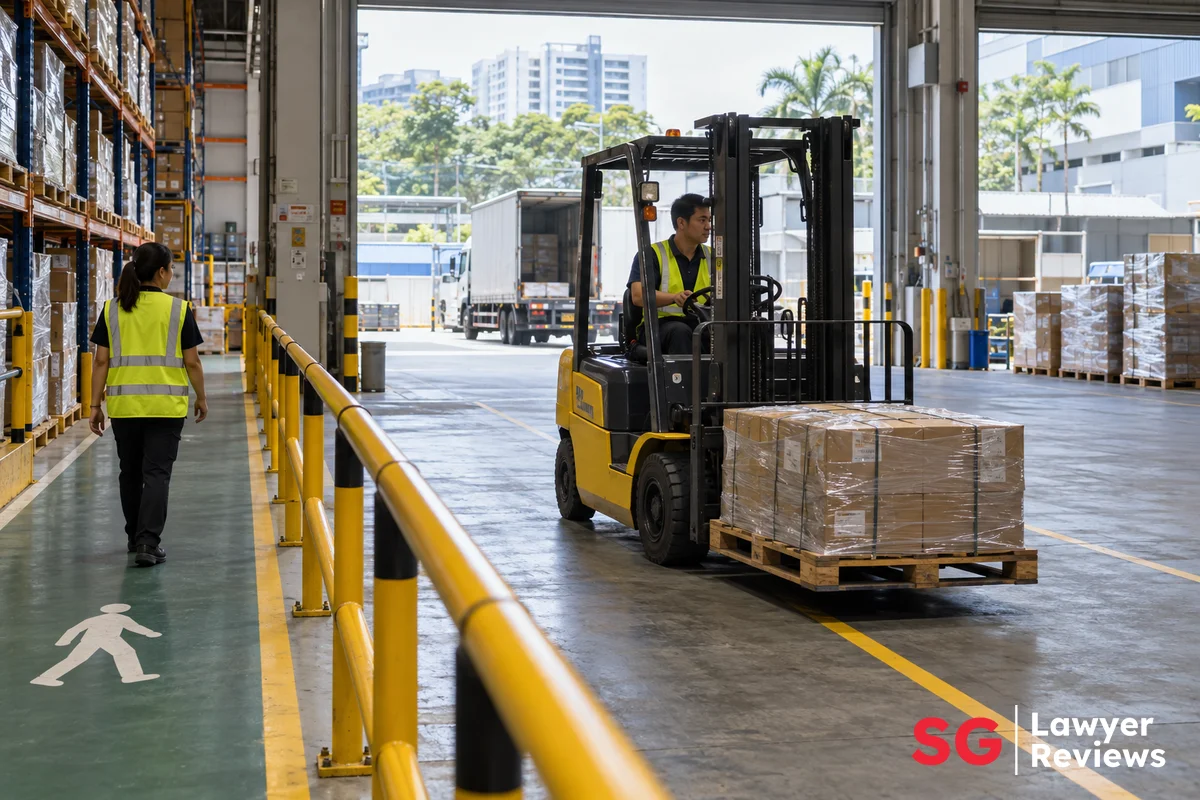
On a worksite, vehicle risk can arise from reversing trucks, forklifts, delivery vans, blind corners, pedestrians crossing loading areas and subcontractors who do not know the local traffic plan. Separate vehicle and pedestrian routes where practicable. Use clear speeds, crossing points, lighting and trained spotters when necessary. Inspect whether a written traffic map matches the site after barriers, stockpiles or access roads change. A plan drafted before construction began may be obsolete halfway through the project.
For a worker travelling between jobs or a platform rider, pressures may include unrealistic delivery timing, fatigue, rain, unfamiliar routes or incentives that reward speed. A workplace assessment should consider how assignments and targets shape behaviour, not only whether the vehicle has working brakes. Listen to reports of near misses. They may reveal a hazardous junction or impossible turnaround before a severe injury occurs.
Small construction projects deserve particular attention
MOM reported that the construction sector’s combined fatal and major injury rate improved to 24.1 per 100,000 in the first half of 2026, down from 27.6 a year earlier. However, smaller-scale works such as additions and alterations and renovation accounted for 70% of the sector’s fatal and major injuries in that period. MOM is reviewing deterrence and accountability for contractors handling this work. A small project is not necessarily a low-risk project.
Limited space often means a van, skip, lift and pedestrians compete for the same access. A condominium or shop renovation may sit next to residents and members of the public. Plan deliveries and unloading so a worker does not have to guide a reversing vehicle while standing in its path. Agree site rules with building management and subcontractors. Our article on contract disputes provides a separate framework if a contractor’s obligations are contested, but an unsafe movement should be stopped and addressed immediately.
What records matter when an incident occurs?
Secure medical care and the scene first. Then preserve the work order, vehicle identity, driver or rider assignment, relevant training, maintenance records, traffic plan and available footage. Record weather, lighting and witness details while memories are fresh. Avoid posting unverified blame on social media. Reporting obligations depend on the facts and the applicable workplace safety and work injury compensation rules, so check MOM’s work accident reporting guidance promptly.
Workers may also need to preserve medical certificates, wage information and correspondence about the incident. Different people may have different routes to compensation, insurance or civil claims. Our personal injury lawyer cost guide helps frame an initial conversation. Do not sign a broad settlement or release without understanding what rights it affects, especially while treatment and the effect on work are still uncertain.
Why a good certificate is not enough
Safety recognition or an approved manual can help organise work, but neither guarantees that a particular delivery lane is safe on a particular day. MOM’s planned review of bizSAFE is significant because it would place greater weight on actual workplace performance. Companies should already test what the certificate means in practice: are supervisors present when high-risk movements occur, are subcontractors inducted, and do near misses lead to changes? If the answer is unclear, collect evidence by observing the job. A brief site walk with workers can reveal blocked sightlines and informal shortcuts that a desk review misses.
Management should also make reporting usable. If a rider or driver expects punishment for every delay, they may hide a dangerous near miss. Set a channel for timely reports, separate learning from deliberate misconduct, and close the loop by explaining what was fixed. A safety culture is reflected in decisions made during a busy shift, when a route is blocked or a deadline is pressing.
A practical response to the September report
Review vehicle-related near misses for the past year and ask whether the same location or task appears repeatedly. Walk routes at the time deliveries actually arrive. Check reversing controls, fatigue management, contractor induction and rider feedback. Assign someone to close each action and record when it was done. Do a short review after a layout or schedule change, not just during an annual audit. If work targets reward risky speed, address the target itself.
MOM’s numbers show meaningful progress in major injury prevention and a serious remaining fatality concern. Both can be true. The useful response is to use the national trend as a prompt for local evidence: what vehicles move in your workplace, who is exposed, which controls genuinely work, and what happened after the last warning sign? Follow the current workplace safety and health guidance as policies develop.
Finally, compare incidents by exposure, not merely by headcount. A company with few drivers can still have high vehicle risk if each worker spends long hours on the road. Record distances, delivery frequency, difficult sites and time of day. This creates a more useful basis for decisions than a single yearly total that hides where risk is concentrated. It also helps management evaluate whether a new route or contract has changed the nature of the work.
Frequently Asked Questions
Were all 21 first-half 2026 deaths caused by vehicles?
No. MOM identified vehicular incidents as the leading cause, accounting for nine of the 21 workplace fatalities reported.
Did the Government make the Safety Time-Out permanent?
The September release describes a two-week nationwide voluntary Safety Time-Out following a cluster of deaths. It does not state that the same exercise became permanent.
Does a national injury-rate improvement reduce an employer’s duty?
No. Employers must assess and manage the risks in their own operations under the applicable workplace safety framework.
Thank you for sharing this article...
About the Author: Randy Alta